
Claims data point to drivers of diagnostic error in inpatient settings
A recent analysis of inpatient diagnostic errors that led to malpractice cases found that 68% occurred in medical-surgical units, compared with 16% in critical care. This finding, along with others, appears in a white paper published earlier this month by Coverys, a medical professional liability insurer based in Boston. The authors note that patients are typically more closely monitored in critical care than in medical-surgical units, which may help explain the disparity in diagnostic accuracy.
“Inpatient diagnostic errors are rarely the result of a single oversight, but rather a systemic challenge stemming from information and communication breakdowns in the face of patient complexity and heavy workloads,” says Dana Siegal, RN, Vice President of Risk Management and Analytics at Coverys and a co-author of the inpatient report. “By identifying these vulnerabilities and challenges and implementing tools like consistent reassessment, structured handoffs, and interdisciplinary collaboration, including patient engagement, health systems can empower care teams to prevent heartbreaking patient harm before it occurs.”
The report on diagnostic error in inpatient settings is the last in a three-part series from Coverys that includes reports on office-based practices and emergency departments. For the inpatient report, Coverys analysts examined clinical claims data from 6,302 cases that closed between 2021 and 2025 and identified 403 events involving diagnostic errors. These events occurred during inpatient care, excluding long-term or rehabilitation care, and did not result from emergency department care.
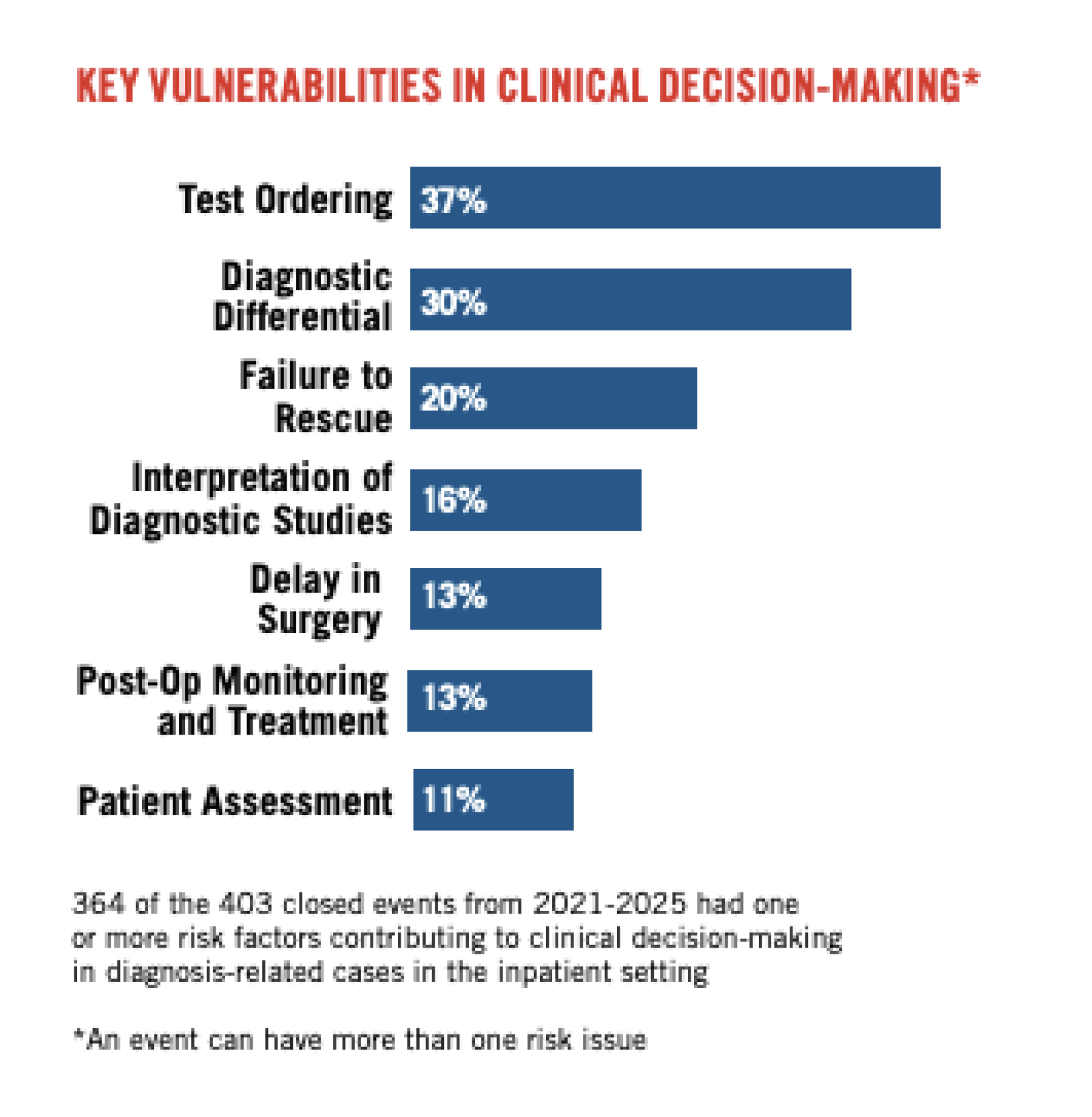
From Part Three: The Inpatient Setting. Used with permission from Coverys.
Among clinical services, hospitalists were involved in 37% of events related to diagnosis, and surgical services in 21%. Radiology and intensive care medicine each accounted for 8% of events, neurology for 5% and cardiology for 4%.
In addition to event analysis, the report outlines best practices for patient monitoring, testing, teamwork, safety culture, and other parts of the diagnostic process. It also provides hospitals with a self-assessment tool to identify areas for diagnostic improvement.