Substance use disorder is top cause of maternal death in Massachusetts, often leading to death months after pregnancy ends

Brooke LaMere, MPH
A Massachusetts Department of Public Health (DPH) committee responsible for reviewing maternal deaths and recommending actions to improve outcomes reports that most recent maternal deaths were preventable. DPH’s Maternal Mortality and Morbidity Review Committee (MMMRC) reviewed 86 pregnancy-related deaths from 2019 through 2024 and found that substance use disorder (SUD) was the leading cause of death. Among deaths during or within one year of pregnancy, the MMMRC found that 35% occurred 43 days to 1 year after the end of pregnancy, when most substance use-related deaths occurred. Other underlying causes included hemorrhage, infection, and embolism.
Using a decision form from the Centers for Disease Control and Prevention, the MMMRC analyzes many sources—the death certificate, hospital records, autopsy, toxicology reports, police records if available, family interviews if conducted, and more—to determine the cause and manner of death and all possible contributing factors.
The decision form includes prompts to distinguish, for example, underlying causes from contributing, immediate, and “other significant” causes. Most maternal deaths involve overlapping, often complex personal and systemic interactions. SUD is the leading cause of death, but these cases usually involve other factors, such as access to care, family support, and bias.
Brooke LaMere, MPH, Maternal Mortality Epidemiologist at DPH and a member of the team that supports the MMMRC, finds that the compounding effects of vulnerabilities tend to affect health outcomes more than any single circumstance. “It's not necessarily one particular thing or one specific instance that causes trouble,” says LaMere. “It's often a combination of lifelong, systems-level circumstances.”
MMMRC also found that, from 2019 to 2024, racial discrimination contributed to pregnancy-related deaths, with non-Hispanic Black birthing people at much higher risk than Hispanics and non-Hispanic Whites.
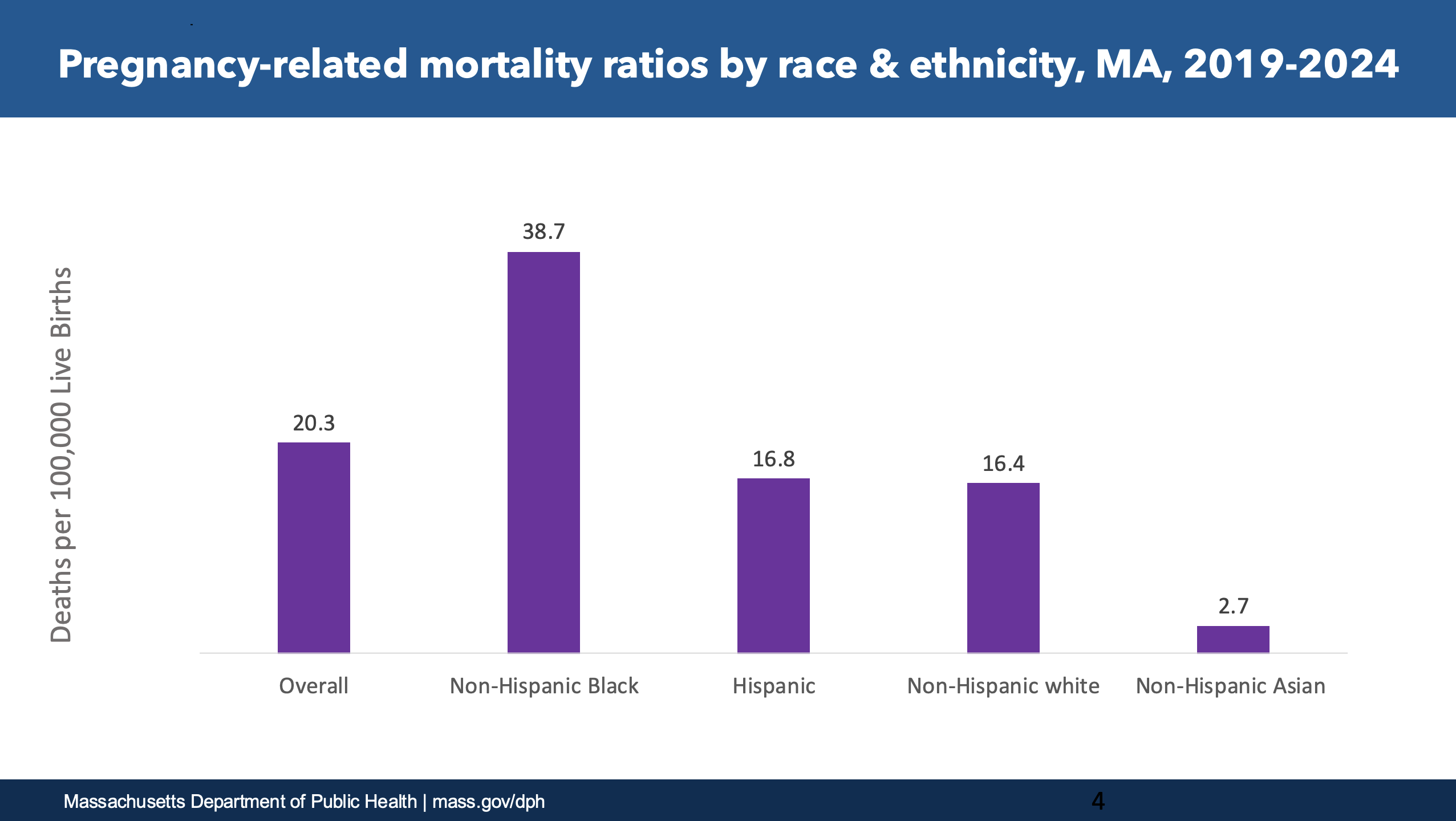
Significant racial disparities persist in pregnancy-related mortality, with non-Hispanic Black individuals experiencing mortality rates more than twice the statewide average.
The MMMRC determined that 85% of maternal deaths from 2019 to 2024 were preventable. The leading factors were problems with continuity of care and care coordination (20%), clinical skills and quality of care (17%), and knowledge (7%). Knowledge deficits included cases in which healthcare professionals failed to provide adequate patient education or lacked the knowledge needed to treat a patient’s condition.
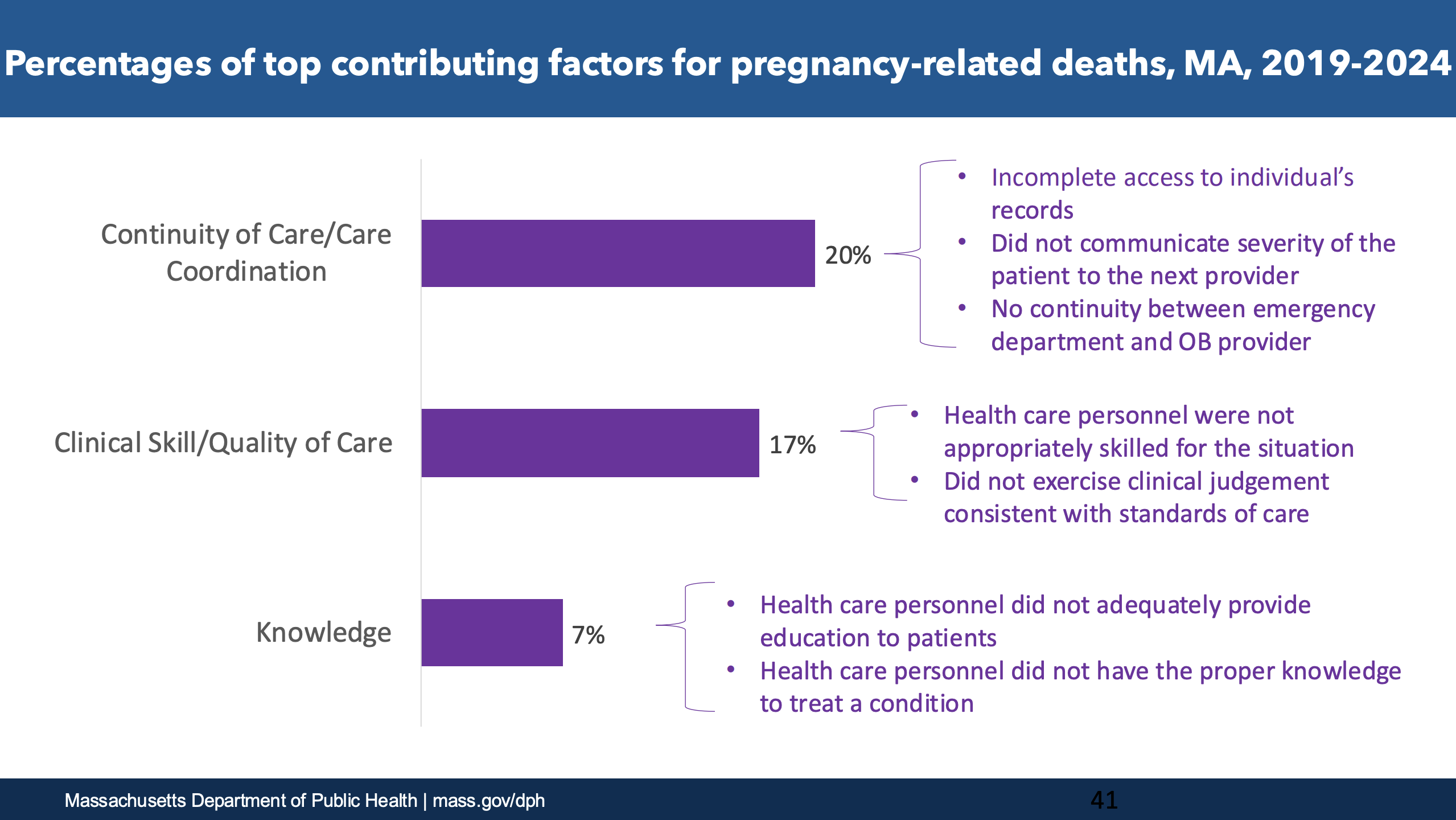
Care coordination and quality of care were the leading contributing factors in pregnancy-related deaths, highlighting opportunities to strengthen communication, continuity, and clinical decision-making across care settings.
In May, MMMRC members Allison Bryant, Laura Kattan, and LaMere presented these and other findings, along with two sample case reports, at the Spring Summit meeting of the Perinatal-Neonatal Quality Improvement Network (PNQIN) of Massachusetts. Their presentation slides are available on PNQIN's website.
With expanded access to records comes a better understanding of the circumstances surrounding maternal deaths
DPH established the MMMRC in 1997 to review maternal deaths, study pregnancy-related health complications, and recommend actions to prevent deaths and improve maternal outcomes. In 2024, a legislative mandate for maternal and child health increased funding for the MMMRC and expanded its authority to request records, including ambulatory prenatal care records, autopsy records, and information on deaths occurring in non-hospital settings.
LaMere notes that the CDC form offers the Committee “yes,” “probably,” “no,” and “unknown” as options for the role of circumstances and the manner of death when reviewing specific cases. “With access to additional records, we've seen the Committee’s use of ‘unknown’ go down,” says LaMere.
The 2024 funding increase also enabled MMMRC to add an experienced community engagement specialist to interview families involved in cases under review.
DPH shares data and learnings with different audiences across the healthcare system
LaMere and others at DPH use presentations, webinars, reports, and other methods to share data and lessons learned from the MMMRC. “The presentations and webinars are really impactful,” says LaMere. “We have dialogue with different audiences at different levels of the healthcare system.”
Based on recent findings, the MMMRC recommended that DPH develop training for emergency department personnel, which will be available as a new online course this fall. LaMere describes this multi-pronged approach, saying, “We try to touch different audiences at different levels. It’s like a Swiss-cheese approach. The legislative report isn't going to fix all the issues. The ED training isn't either, but together we can reduce the maternal mortality numbers.